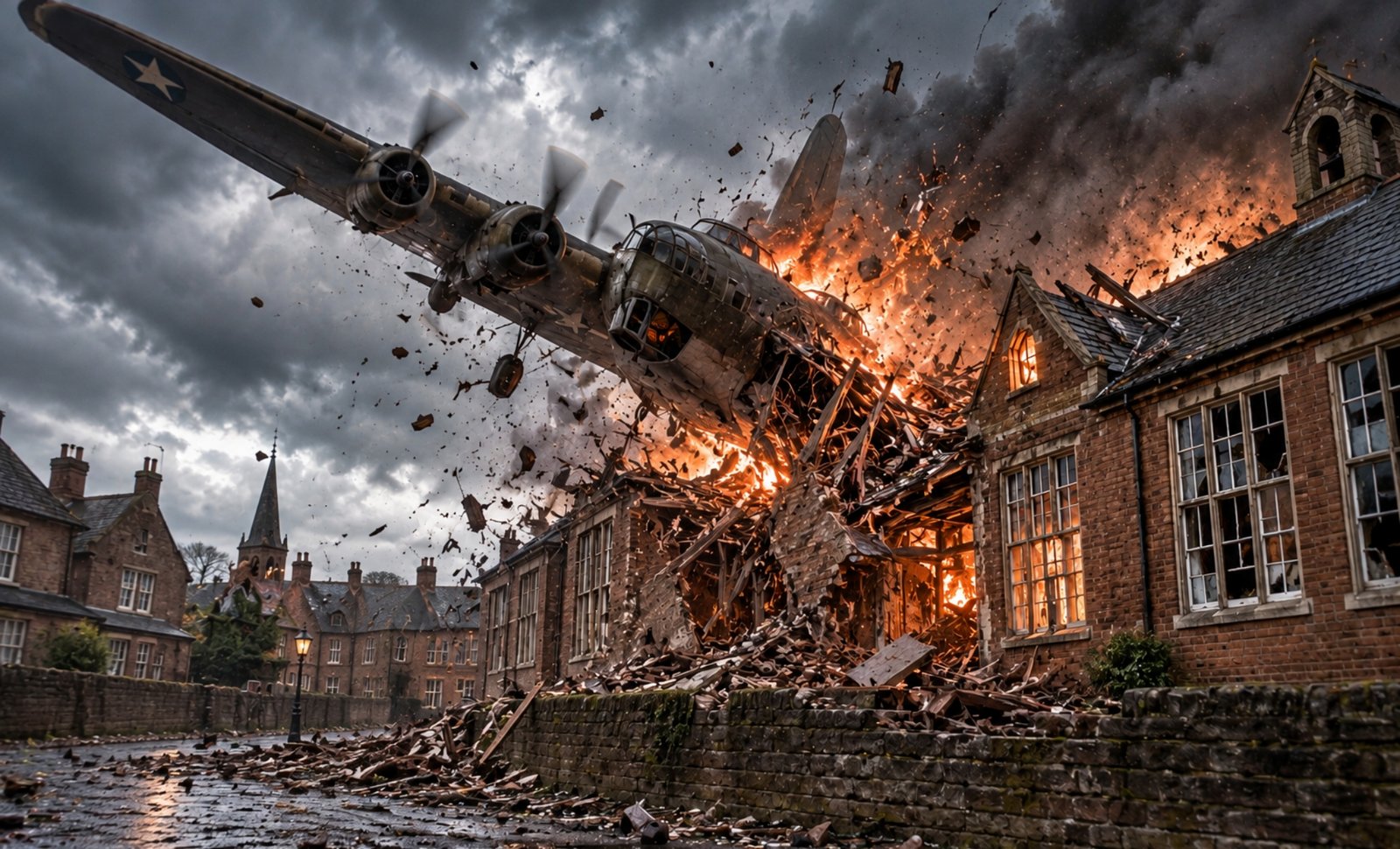
A classroom clock stopped at 10:47 a.m. on August 23, 1944, in Freckleton, a village in northwest England. Outside, a violent thunderstorm had darkened the sky. Inside Holy Trinity School, teachers were trying to keep their youngest pupils calm.
Some children had put their heads down on their desks while their teachers read to them. Nearby, American servicemen were sheltering from the rain in a café. Less than 20 minutes earlier, a military bomber had taken off from an airfield just outside the village.
The aircraft crashed into Holy Trinity School and surrounding buildings, igniting a fire that killed 61 people, including 38 children aged 4 to 6. Of the 41 pupils in the infants’ wing, just three survived. The disaster became one of the deadliest aviation accidents of World War II, yet its story remains far less familiar than the battles taking place that same summer.
Two American Bombers Flew Into a Rapidly Worsening Storm
Freckleton’s wartime life was closely connected to nearby Warton Aerodrome, where thousands of American military personnel maintained aircraft for operations across Europe.
The installation, known as Base Air Depot 2, repaired and modified heavy bombers, including the B-24 Liberator. American servicemen visited village pubs, attended local churches and developed friendships with residents. Their presence earned the area the nickname Little America.
As detailed in BAE Systems’ history of Warton, the airfield was a major maintenance center supporting the United States Army Air Forces.
/https://tf-cmsv2-smithsonianmag-media.s3.amazonaws.com/filer_public/82/0e/820ee920-d5e6-4ab0-b138-14a183ca3591/fre_011566.jpg)
At approximately 10:30 a.m. on August 23, First Lieutenant John Bloemendal took off in a refurbished bomber named Classy Chassis II, accompanied by two crew members. Another B-24 departed on a separate test flight shortly afterward.
Neither flight was intended to be a combat mission. Both aircraft were being tested before returning to military service.
But within minutes, a severe thunderstorm developed around the airfield. Winds approached 60 mph (97 km/h), rain sharply reduced visibility, and both aircraft were ordered back.
As recorded in Lancashire’s local parish history, Bloemendal abandoned his landing approach at the last moment. His aircraft subsequently descended toward Freckleton, struck trees and buildings, and tore through the Sad Sack Snack Bar before parts of the wreckage crashed into the school.
Ruptured fuel tanks ignited, spreading flames through the damaged buildings.
The Youngest Classroom Suffered the Greatest Loss
The aircraft struck the school during the second day of the new academic year. Its youngest pupils were gathered in the infants’ wing, where teachers Louisa Hulme and Jennie Hall were looking after them.
The impact and resulting fire devastated their classrooms. Headmaster F. A. Billington, who suffered burns while helping pupils escape, later described hearing a violent cracking sound as windows shattered and flames spread.
Among the children was five-year-old Ruby Currell, who survived by hiding underneath her desk. Rescuers eventually reached her through the wreckage and carried her outside.
Another survivor, David Madden, escaped through a burning doorway. In a 2024 documentary interview, he recalled his instinctive response: “I just wanted to go outside, so I ran.”
The third surviving pupil was George Carey. All three suffered serious burns and faced prolonged medical treatment.
/https://tf-cmsv2-smithsonianmag-media.s3.amazonaws.com/filer_public/da/ae/daae3ba5-c3a4-4c36-9186-6723e4353095/rescuers_searching_through_demolished_school_after_aberfan_disaster.jpg)
The destruction extended beyond the school. The nearby café, which served American and British military personnel, was also devastated. Civilians, servicemen and the three men aboard the bomber were among those killed.
American military personnel joined local residents and emergency workers in the rescue operation. Some searched through burning debris with their bare hands, while others helped transport the injured to medical facilities.
The eventual death toll included victims who survived the initial collision but died from their injuries in the following days. Both teachers from the infants’ wing were among the dead.
Investigators Could Not Establish Precisely Why the Plane Crashed
The thunderstorm was central to the sequence of events, but the exact mechanism that brought down the aircraft has never been conclusively established.
American military investigators examined the accident and considered whether Bloemendal had underestimated the severity of the weather. A powerful downdraft during the attempted maneuver was one possible explanation.
Other accounts raised the possibility of a lightning strike interfering with the aircraft. Neither explanation could be conclusively demonstrated.
The bomber had been almost completely destroyed, its crew had died, and eyewitness accounts could not reconstruct every movement of the aircraft.
/https://tf-cmsv2-smithsonianmag-media.s3.amazonaws.com/filer_public/08/9c/089c435b-016a-4d93-8de5-52b7d6f6ac24/media-40683.jpeg)
A detailed 2019 investigation published by The Independent examined the weather conditions, the aborted landing and the limitations faced by investigators.
The tragedy also exposed the risks of rapidly changing British weather for American aircrews. The military investigation recommended better warnings about severe local storms.
There was no enemy attack, no bombing mission over occupied Europe and no battle taking place above Freckleton. The disaster occurred during a routine test flight close to an Allied airfield.
Freckleton Continued Remembering the Children Long After the War
On August 26, 1944, the village held a mass funeral. American servicemen helped prepare the communal grave and carried children’s coffins to their burial place beside Holy Trinity Church.
Hulme, who had been due to retire shortly after the accident, reportedly asked to be buried alongside her pupils. Her wish was honored.
/https://tf-cmsv2-smithsonianmag-media.s3.amazonaws.com/filer_public/bc/67/bc67e7cd-5e2c-4ce2-89ef-dbe16c632594/freckleton-coffins.png)
Today, the Imperial War Museums’ memorial register documents the monument in the churchyard, which records the names of the two teachers, 38 pupils and seven other civilians buried there. A separate roadside plaque commemorates all 61 victims.
The former school site received its own plaque in 2007, decades after the accident. Annual commemorations and reunions have also maintained the connection between the village and the American military personnel who once served nearby.
During the 80th anniversary commemorations in 2024, survivors and relatives again shared their experiences. Angela Procter spoke about her older sister Georgina Lonsdale, who was killed at age four before Angela was born.
The accident was also revisited in a substantial Smithsonian Magazine historical feature published in August 2026. Currell’s efforts to preserve her classmates’ memories have remained an important part of the story.
The village’s earliest collective memorial took a different form. On August 20, 1945, roughly 800 American servicemen’s efforts culminated in the opening of a three-acre memorial playground and garden, funded by donations from their ranks. According to Freckleton Parish Council’s heritage history, the project cost £2,600 and included a seven-ton memorial stone dedicated to the children of Freckleton.

Ghiles Houari is a writer based in Algeria with a technical background in applied science and industrial electronics. He is naturally curious about how things work, from everyday technology to the systems and ideas shaping the modern world.
With his hands-on technical training, Ghiles brings a practical and thoughtful perspective to his writing. He focuses on making science, technology, electronics, and innovation clear, interesting, and easy to understand.
For him, good writing is not just about explaining facts — it is about helping readers see why they matter.
Leave a Reply