A row of microscopic teeth runs along the wing of a fossil insect from Inner Mongolia. When the animal was alive, those teeth moved against a scraper on the opposite wing. Each pass set part of the wing vibrating and produced a call.
The insect died roughly 165 million years ago. Its calls disappeared immediately, but the parts that made them did not. Hardened wing structures can survive fossilization with enough detail to retain information about their dimensions, tooth spacing and vibrating surfaces.
Using those traces, researchers have reconstructed calls from 20 Middle Jurassic fossils representing nine insect species. Five were estimated to produce low, pure tones around 5 to 7 kilohertz. Several others called above 10 kilohertz. One, Sigmaboilus peregrinus, reached about 20.4 kilohertz, placing its reconstructed signal just into ultrasound. According to the study published in PNAS, the fossils all came from the Jiulongshan Formation near Daohugou in Inner Mongolia and date to between about 157 million and 165 million years ago. The group forms the oldest paleo-acoustic assemblage yet assembled.
The reconstruction depends on a useful property of these insects: the wing was not merely moving air. It was part of the instrument.
The Frequency Is Built Into the Wing
Crickets, katydids and their relatives produce calls through stridulation. A serrated vein called the stridulatory file moves across a plectrum, or scraper, on the other wing. Sound is produced mainly as the wings close.
The wing itself has natural resonant frequencies. In a living insect calling near 5 kilohertz, for example, the sound-producing region is also built to vibrate efficiently near that frequency. Tooth strikes drive the wing at the required rate, while specialized membranes radiate the resulting sound.
That connection gave the fossil wings something measurable.
Before applying their models to extinct species, the researchers tested them against living insects whose calls could still be recorded. Laser Doppler vibrometry measured real wing vibrations, while computer simulations modeled the same wing geometries. For three living species, the simulated resonances closely tracked both the measured wing vibrations and the frequencies of their calls.
Then the same approach was turned on the fossils.
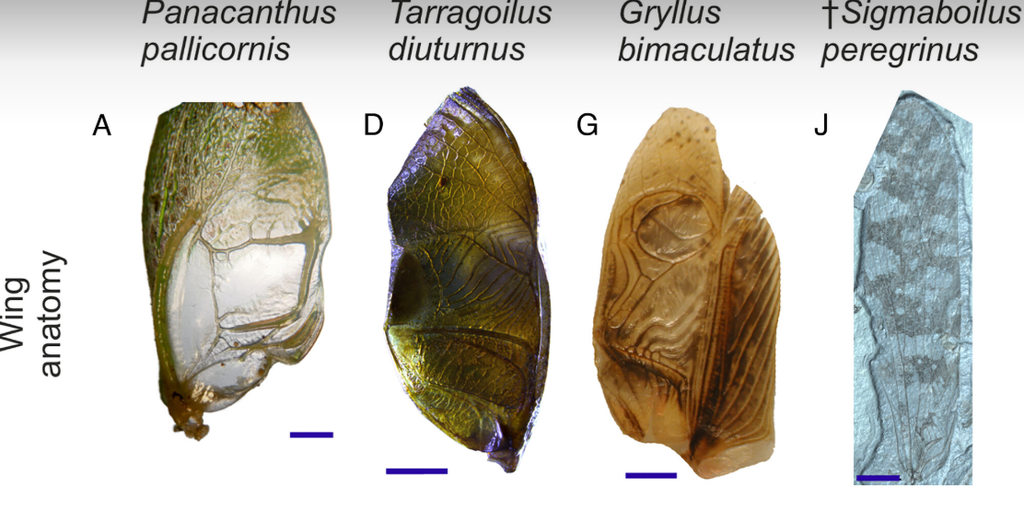
For S. peregrinus, a finite-element model produced a wing resonance at 20.50 kilohertz. A separate prediction based on the relationship between wing anatomy and calling frequency produced 20.42 kilohertz. The two estimates arrived at nearly the same value by different routes.
That was not the only acoustic information preserved in the stone.
The spacing of individual teeth along a stridulatory file can change how a call develops during a wing stroke. Three specimens of Archaboilus polyneurus showed a repeated pattern in which the gaps between teeth increased and decreased. Four specimens of Allaboilus gigantus carried a file divided into two distinct regions, one with relatively constant tooth density and another with irregularly spaced pegs. Those structures would have generated different temporal and frequency patterns as the wings moved.
Other fossil species had more regular files suited to pure tones. Wing size varied as well. The result was not one generic Jurassic insect call scaled up or down, but a collection of mechanically different sound-producing systems.
Reconstructing a Call Is Not the Same as Replaying a Song
The fossil record becomes less informative once anatomy gives way to behavior.
A single closing movement of the wings produces a basic call unit known as a syllable. The physical structure of a fossil wing can constrain the frequency of that syllable, but a complete song also depends on how quickly the insect repeats it, how long it pauses and how its nervous system controls the sequence.
Those behavioral instructions leave no fossil.
To estimate part of the missing timing, the researchers used measurements from living species to build a statistical model relating features such as file length, tooth number, dominant frequency and syllable duration. They combined the resulting estimates with the reconstructed frequencies to assemble a version of the Jurassic soundscape. A Science report on the work describes how those reconstructed calls were used to approximate what the ancient insect community may have sounded like.
The underlying fossil evidence is more direct for some parts of that reconstruction than others. Wing shape and stridulatory structures are physically preserved. Resonance can be modeled from them. The longer temporal pattern of the song has to be estimated from living insects.
The fossils nevertheless preserve enough variation to separate the nine species acoustically. Five fall between about 5 and 7 kilohertz. Aboilus stratosus, Novaboilus multifurcatus and S. peregrinus were among the species reconstructed above 10 kilohertz. The highest estimate, for S. peregrinus, passed the roughly 20-kilohertz boundary commonly used to define ultrasound in relation to human hearing.
That date also places the signal far earlier than bats in the fossil record. The Jurassic insects lived around 165 million years ago; bats appeared in the Eocene, about 55 million years ago. An Eocene katydid fossil has previously allowed researchers to reconstruct both signaling and hearing at 32 kilohertz, but the new S. peregrinus estimate moves evidence for ultrasonic insect communication much deeper in time.
The closest living relatives of many of the fossils belong to Prophalangopsidae, insects sometimes called grigs. Their wing shapes and stridulatory behavior retain features resembling those seen in the Jurassic forms, which is why living members of the family were useful in testing how the ancient wings may have worked.
About 100 species of Prophalangopsidae have been described. Only nine living species remain, scattered through temperate habitats in China, India, Russia, the United States and Canada.

Farid Amber is a Canada-based writer and Editor-in-Chief who covers technology, space, and the environment. With a strong technical background, he brings a clear and practical perspective to stories about innovation, science, and the future of our planet.
His education includes a diploma in Applied Science, a master’s degree in Industrial Electrical Engineering, and a diploma in Electromechanical Automated Systems. This gives him a deep understanding of how modern technologies work, from complex engineering systems to the ideas driving new discoveries.
As Editor-in-Chief, Farid focuses on making complex topics easy to read, accurate, and meaningful. His goal is to help readers understand not only what is happening in the world of science and technology, but why it matters.


Leave a Reply