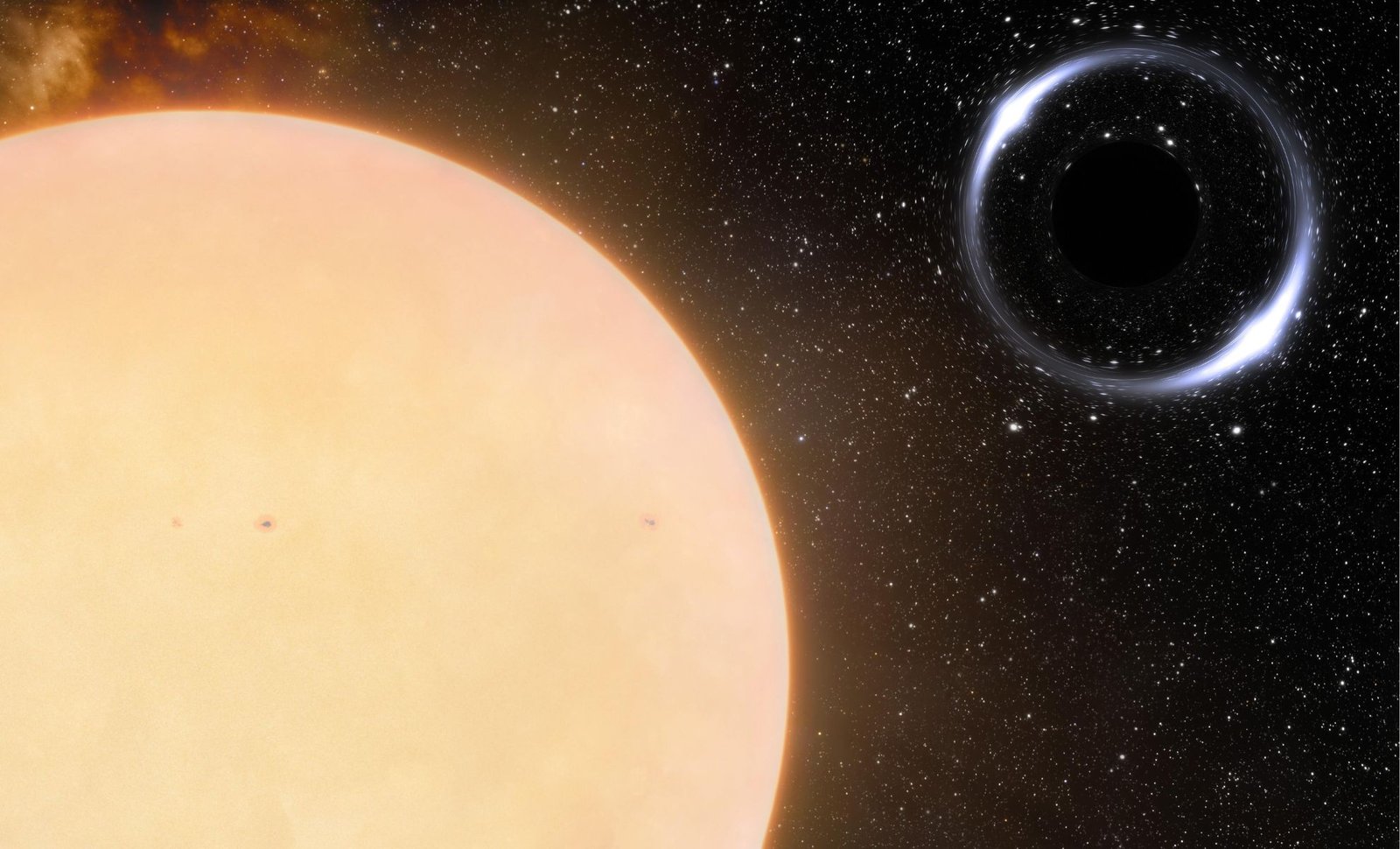
A star in the constellation Ophiuchus is moving around something that telescopes cannot see. Its orbit reveals the gravitational pull of an invisible object roughly ten times more massive than the Sun. That object is Gaia BH1, the closest known black hole to Earth, located approximately 1,560 light-years away.
Astronomers first identified this unusual system in 2022, and subsequent discoveries have not displaced its distance record. The black hole has an ordinary-looking stellar companion, yet it produces none of the bright X-ray emissions that traditionally help astronomers locate these extreme objects. Its discovery revealed an overlooked population of hidden black holes and a stellar partnership that remains difficult to explain.
An Unusual Stellar Wobble Exposed the Invisible Object
The first clue came from the European Space Agency’s Gaia spacecraft, which measured the positions and movements of stars across the Milky Way with extraordinary precision. Astronomers noticed that one Sun-like star was tracing a peculiar path through space, suggesting that it was orbiting a massive companion that emitted no detectable light.
The research team, led by astrophysicist Kareem El-Badry, examined orbital measurements for 168,065 binary-star candidates in Gaia’s third data release. They narrowed the search to six promising systems before using additional observations to investigate their motions. One candidate stood out: a seemingly normal star whose orbit demanded an exceptionally massive, unseen companion.
Observations from Gemini North in Hawaii, the Magellan telescopes in Chile, and other ground-based facilities helped establish the system’s orbital properties. By combining Gaia’s measurements of the star’s position with its radial velocity, astronomers reconstructed its three-dimensional movement and calculated the mass of the invisible object.
“The accuracy of Gaia’s data was essential for this discovery,” Timo Prusti, ESA’s Gaia project scientist, explained in the agency’s report.
A Massive Black Hole Hiding Beside an Ordinary Star
The observations produced an extraordinary result. The invisible companion has an estimated mass of 9.62 times that of the Sun, with an uncertainty of just 0.18 solar masses. Meanwhile, the visible star weighs approximately 0.93 solar masses and closely resembles our own Sun.
The two objects complete an orbit every 185.6 days. Their orbital separation is characterized by a semimajor axis of approximately 1.4 astronomical units, slightly greater than the average distance between Earth and the Sun. The orbit is elliptical rather than perfectly circular, bringing the star closer to and farther from its invisible companion during each revolution.
The most decisive evidence was not simply the star’s unusual motion. According to the team’s original study in Monthly Notices of the Royal Astronomical Society, even an ordinary star of only five solar masses would be approximately 500 times brighter than the entire observed system. Yet astronomers found no additional stellar light capable of accounting for the gravitational pull.
That combination of enormous mass and missing light pointed to a black hole. Unlike an actively feeding black hole, which can generate intense radiation as surrounding gas heats up, Gaia BH1 is dormant. Its companion is sufficiently separated from it that substantial accretion is not taking place, leaving gravity as the principal evidence of its existence.
The Companion Star Creates a Difficult Cosmic Puzzle
Finding a black hole so close to Earth was remarkable, but the system’s apparent history introduced another mystery. The star that eventually collapsed into Gaia BH1 would have begun its life with at least 20 times the Sun’s mass. Before its collapse, it would have expanded enormously as it approached the final stages of stellar evolution.
That expansion should have dramatically affected the smaller companion. In conventional binary evolution models, a massive star can engulf a nearby partner in a shared envelope of gas, causing the two objects to spiral closer together. Yet the surviving star in Gaia BH1 looks relatively ordinary and occupies a much wider orbit than these models would typically predict.
Researchers have considered alternative explanations, including interactions with other stars inside a stellar cluster. Another possibility involves an originally more complicated system containing three stars, rather than two. The unseen mass might even involve a compact pair containing more than one collapsed object, although the observations strongly require a black hole.
As El-Badry explained in the Max Planck Institute for Astronomy’s account of the discovery, having one such system available for study was a major advance over having none. Its unusual structure provides a valuable test for theories describing how massive stars evolve and how black holes acquire their companions.
Other Black Holes Have Since Been Found Nearby
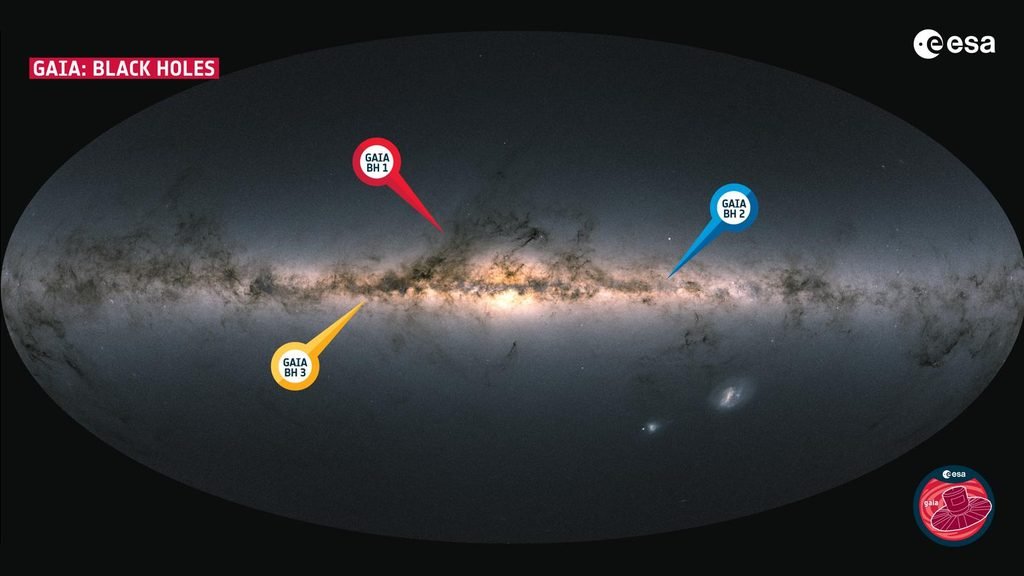
Gaia BH1 was not the last invisible object uncovered through this method. In 2023, astronomers announced Gaia BH2, another dormant stellar-mass black hole associated with a visible companion. Located approximately 3,800 light-years away in the constellation Centaurus, it offered further evidence that quiet black holes could be found by examining the motions of ordinary stars.
A more extraordinary discovery followed in April 2024. Scientists identified Gaia BH3, a black hole with approximately 33 solar masses in the constellation Aquila. At around 1,926 light-years from Earth, it was considerably more massive than Gaia BH1 but remained farther away.
The three systems now provide different examples of dormant black holes hidden within the Milky Way. Their locations are documented in the European Space Agency’s map of Gaia black holes, which places BH1 nearest Earth, followed by BH3 and then BH2.
These discoveries also illustrate an observational bias. Historically, many stellar-mass black holes were identified because material falling toward them produced detectable X-rays. Systems lacking that luminous activity could remain invisible even when relatively nearby, leaving their true abundance poorly constrained.

Farid Amber is a Canada-based writer and Editor-in-Chief who covers technology, space, and the environment. With a strong technical background, he brings a clear and practical perspective to stories about innovation, science, and the future of our planet.
His education includes a diploma in Applied Science, a master’s degree in Industrial Electrical Engineering, and a diploma in Electromechanical Automated Systems. This gives him a deep understanding of how modern technologies work, from complex engineering systems to the ideas driving new discoveries.
As Editor-in-Chief, Farid focuses on making complex topics easy to read, accurate, and meaningful. His goal is to help readers understand not only what is happening in the world of science and technology, but why it matters.
Leave a Reply