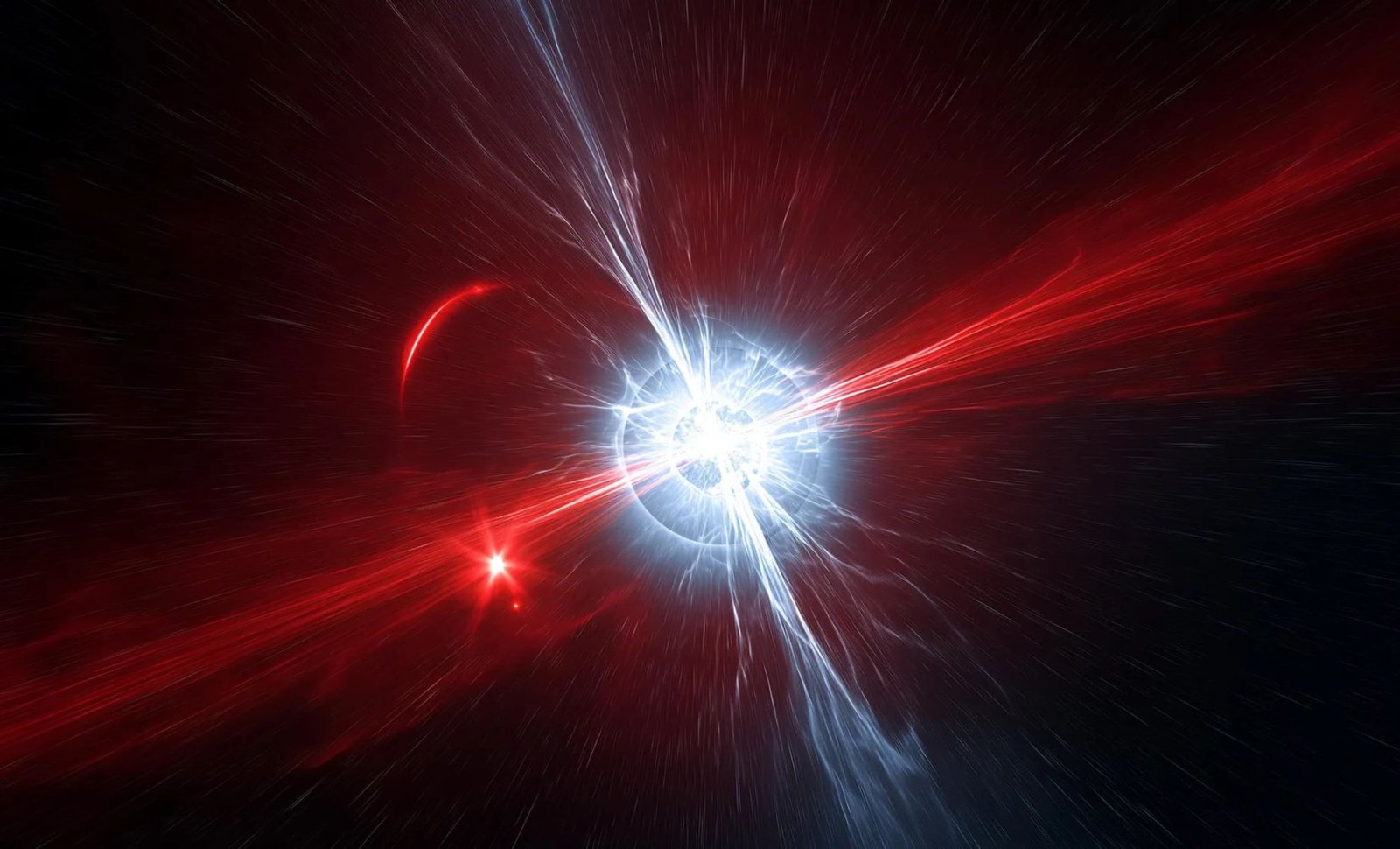
Every 1.4 hours, something in the Milky Way appears to switch on. It flashes in radio waves, glows in X-rays, then fades again with a rhythm too regular to dismiss as cosmic noise.
Astronomers now say they have traced that repeating signal from space to a rare stellar pair: a dense white dwarf pulling material from a nearby companion star. The finding, published in Nature Astronomy, offers one of the clearest explanations yet for a puzzling group of objects known as long-period radio transients.
The system, called ASKAP J1745−5051, is important because it gives researchers more than a strange signal. It gives them a physical source to study. Instead of an isolated pulse with an uncertain origin, astronomers now have evidence of two stars in a tight orbit, producing radio and X-ray emission as they move around each other.
A Signal That Kept Time
ASKAP J1745−5051 was first identified using CSIRO’s Australian SKA Pathfinder, or ASKAP, a radio telescope designed to scan large areas of the sky. The source stood out because its radio emission was strongly polarized, meaning the waves appeared to be shaped by an organized magnetic environment.
The object belongs to a rare class called long-period radio transients. These signals repeat on timescales of minutes to hours, much slower than many familiar pulsar signals. Only about a dozen have been found, and astronomers have debated whether they come from unusual neutron stars, white dwarf systems, or several different types of objects.
This time, the evidence pointed to a binary system. Lead author Kovi Rose, from the University of Sydney and CSIRO, said in a University of Sydney release: “For the first time we have pinpointed the origin of these signals, confirming the source to be a ‘cataclysmic variable’, or an accreting white dwarf star.”
A Dead Star Pulling From Its Companion
A white dwarf is the dense remnant left behind after a star like the Sun exhausts its fuel. In ASKAP J1745−5051, the white dwarf appears to orbit a much smaller companion, likely a red dwarf with about one-tenth the mass of the Sun.
The pair circles each other on a 1.4-hour cosmic clock. At that distance, the white dwarf can pull gas from its companion. As that material moves toward the compact star, it heats up and can produce X-rays. Charged particles moving through magnetic fields may also help generate radio bursts strong enough to be detected across the galaxy.
That timing is the crucial clue. The radio bursts and X-ray emission vary on a similar rhythm, linking the strange signal to the motion of the two-star system. The signals do not peak at exactly the same time, suggesting they may come from different regions around the binary.
The Evidence Came From Several Kinds of Light
Radio bursts alone would not have been enough to identify the source with confidence. The team followed ASKAP J1745−5051 across radio, optical, ultraviolet and X-ray wavelengths, building a case from several independent clues.
Gaia data helped connect the radio source to a visible counterpart. Optical spectroscopy from telescopes including SOAR and Magellan revealed hydrogen and helium emission lines, which are consistent with a cataclysmic variable, a binary system where a white dwarf accretes material from a companion. X-ray observations from Swift, eROSITA archival data and Einstein Probe showed emission changing on a timescale close to the orbit.
Together, the observations pointed toward an accreting white dwarf binary with strong magnetic activity. The Nature Astronomy paper also notes that ASKAP J1745−5051 is unusually radio-luminous compared with nearly all known radio stars and brighter than expected compared with known cataclysmic variables.
A New Clue to One of Space’s Slowest Mysteries
Long-period radio transients have been hard to classify because they do not fit neatly into familiar categories. They are not ordinary fast radio bursts, and they are not straightforward pulsars. Their slow repetition has raised the possibility that different kinds of objects may produce similar-looking signals.
ASKAP J1745−5051 does not solve every case. The careful conclusion is that white dwarf binary systems may explain at least part of this population. Other long-period radio transients may still have different origins.
That is why this system is useful. It gives astronomers a template for future searches: look for an orbit, an optical counterpart, X-rays, polarization and signs of accretion. If other slow repeating radio signals show the same pattern, researchers may be able to connect more of them to compact stellar binaries.
The Signal Has a Source, but Not Every Answer
The study does not prove that every long-period radio transient comes from a white dwarf binary. It also leaves some details of ASKAP J1745−5051 unresolved. The companion is thought to be a low-mass red dwarf, but nearby light sources and the accretion structure may complicate estimates.
The exact type of magnetic cataclysmic variable is also still uncertain. The system may be a polar or an asynchronous polar, but a firmer classification will require a better understanding of the white dwarf’s spin period.
For now, the pulse is still strange, but it is no longer just a pulse. It is the sign of a stellar machine, ticking every 1.4 hours somewhere in the Milky Way.

Ghiles Houari is a writer based in Algeria with a technical background in applied science and industrial electronics. He is naturally curious about how things work, from everyday technology to the systems and ideas shaping the modern world.
With his hands-on technical training, Ghiles brings a practical and thoughtful perspective to his writing. He focuses on making science, technology, electronics, and innovation clear, interesting, and easy to understand.
For him, good writing is not just about explaining facts — it is about helping readers see why they matter.



Leave a Reply