
There is a particular kind of quiet revolution that happens when a technology stops being a theory and starts showing up in the real world. It doesn’t always arrive with a flashy product launch. Sometimes, it arrives in a beam of light you cannot even see flickering.
For the past decade, most of us have accepted Wi-Fi for what it is: convenient, occasionally frustrating, and increasingly crowded. Every smart bulb, doorbell camera, and streaming box in your home fights for space on the same radio frequency spectrum. But a different kind of wireless connection—one that uses the LED bulbs already hanging in your ceiling has just received its official stamp of approval. It is called Li-Fi, short for Light Fidelity, and in July 2023, the Institute of Electrical and Electronics Engineers (IEEE) formally approved the IEEE 802.11bb standard, placing Li-Fi in the same family as every version of Wi-Fi you have ever used.
To understand what that means, forget the router behind your television. Look up at the light instead.
A TED Talk That Turned Out to Be Prophetic
The idea was first shown to a global audience in 2011. Professor Harald Haas, a mobile communications engineer at the University of Edinburgh, stood on a TED Global stage and did something that seemed almost too simple. He took a single LED light bulb, streamed a high-definition video through it, and let the audience watch the feed drop the moment he put his hand in front of the beam.
“All we need to do,” Haas told the audience that day, “is fit a small microchip to every potential illumination device, and this would then combine two basic functionalities: illumination and wireless data transmission.”
More than a decade later, Haas’s company, pureLiFi, has turned that demonstration into a commercially available technology. According to the company’s official documentation, Li-Fi is “wireless connectivity through light.” The mechanism is elegant in its simplicity. An LED bulb is switched on and off millions of times per second. Those imperceptible pulses represent binary code ones and zeros. A photodetector on your laptop or phone reads those pulses and converts them back into data. The human eye sees only steady, warm light. The machine sees a firehose of information.
Why Light Leaves Radio in the Dust
To grasp why this matters, you have to understand how cramped the radio frequency spectrum has become. Your Wi-Fi router typically operates on the 2.4 GHz or 5 GHz bands. So does your neighbor’s router. So does your microwave, your cordless phone, and every Bluetooth speaker within range. According to industry projections cited by multiple research firms, there will be more than 75 billion connected Internet of Things (IoT) devices worldwide by 2030. All of them are competing for the same limited slice of the electromagnetic spectrum.
Li-Fi operates in the visible light spectrum, between 400 and 800 terahertz. That is a band roughly 10,000 times larger than the entire radio frequency spectrum used for wireless communication today. As pureLiFi notes on its website, Li-Fi can offer “massive bandwidth and more stable connections, and in the future multiple Gbps speeds.” Independent laboratory tests have demonstrated theoretical speeds of up to 100 Gbps. To put that number in context: at that rate, you could download a full-length, high-definition feature film in less than one second.
The Room You Are In Is Now A Secure Zone
Speed is only part of the story. Security is where Li-Fi offers something that Wi-Fi, by its physical nature, cannot match.
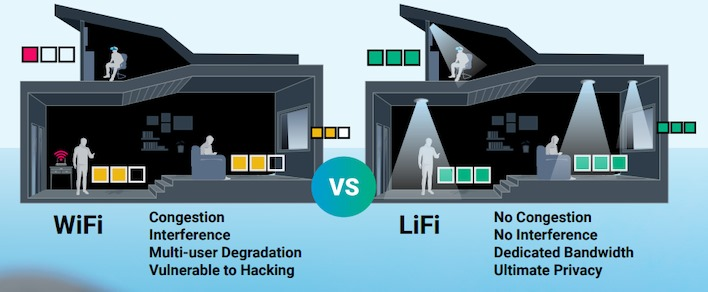
Radio waves travel through walls. That is why you can walk from your kitchen to your bedroom and stay connected. But it is also why someone sitting in a car outside your home can, with the right equipment, detect your Wi-Fi signal. Encryption helps, but the signal itself remains exposed.
Li-Fi signals do not pass through opaque walls. Light stops at the door. According to pureLiFi, the technology offers “game changing security for wireless communications” and is “already used by both defence and government organisations to enable connectivity where never before possible.” If you are in a conference room discussing sensitive financial data or patient records, that data physically cannot leak into the hallway. For government buildings, military installations, and hospital operating rooms, this is not a minor convenience. It is a fundamental advantage that no amount of Wi-Fi encryption can fully replicate.
Where Wi-Fi Has Always Struggled
Hospitals are among the most promising early adopters. Walk into any modern intensive care unit, and you will find ventilators, patient monitors, and infusion pumps that can be disrupted by radio frequency interference. Li-Fi provides high-speed connectivity without any electromagnetic risk. Several hospitals in Europe have already launched pilot programs, according to industry reports.
Aviation is another natural fit. Aircraft cabins are metal tubes that reflect and distort radio signals. Air France has conducted tests using Li-Fi to deliver in-flight internet through the overhead reading lights above each seat. The same principle applies to industrial settings like oil refineries and chemical plants, where even a tiny radio spark could have catastrophic consequences. In those environments, Li-Fi is not just faster. It is safer.
Retailers are paying attention for a different reason. Because Li-Fi signals are highly localized, they enable indoor positioning with a precision that GPS and Bluetooth beacons cannot match. A shopper walking through a department store could receive product information and navigation help from the specific light fixture above each aisle automatically, without any app-based check-in.
And then there is broadband deployment. pureLiFi highlights an often-overlooked advantage: Li-Fi enables “fast and low-cost deployment of outdoor consumer premises equipment. Eliminate the need to drill through walls to bring data inside the building.” For rural areas or older buildings where fiber installation is prohibitively expensive, a Li-Fi link from a streetlight to a rooftop receiver could bypass construction costs entirely.
The Standard That Changed Everything
For years, critics dismissed Li-Fi as a lab curiosity. Without a formal industry standard, manufacturers had no common framework to build compatible devices. That objection evaporated in July 2023.
The IEEE 802.11bb standard officially incorporated Li-Fi into the same family as Wi-Fi. The designation means that Li-Fi can now be integrated alongside existing wireless infrastructure using common protocols. Device manufacturers can build Li-Fi receivers into chips with confidence that they will work across different brands. pureLiFi worked closely with the IEEE to define those technical specifications, and the approval has accelerated interest from major enterprise customers.
Signify, the company formerly known as Philips Lighting and one of the largest lighting manufacturers in the world, has already launched its own Li-Fi product line under the brand name Trulifi. Oledcomm, a French company, offers the LiFiMAX series. Even Panasonic has invested in Li-Fi research. According to multiple market analyses, the Li-Fi industry is expected to grow to roughly $36 billion by 2028, with an annual expansion rate near 70 percent.
What Li-Fi Still Cannot Do
None of this means you are throwing away your home router tomorrow.
Li-Fi has real limitations, and understanding them is essential. First, light requires line of sight or a reflected path. If you walk between the LED bulb and your device, the signal drops. If you leave the room, it drops. Light does not bend around corners or pass through furniture. That makes Li-Fi a room-level technology, not a whole-home solution.
Second, the light must remain on. It can be dimmed to levels that are barely perceptible to the human eye, but it cannot be turned completely off. That is impractical for a bedroom at night or a darkened conference room during a slide presentation.
Third, sunlight interference remains a challenge for outdoor use. Direct sunlight can overwhelm a photodetector, making it difficult to distinguish the modulated LED signal from ambient light. Engineers are developing filters and signal processing to mitigate this, but outdoor Li-Fi is not yet as reliable as indoor deployment.
Finally, device compatibility is the biggest short-term hurdle. Your current smartphone, laptop, and tablet do not have built-in Li-Fi photodetectors. Until Apple, Samsung, or Google begin integrating that hardware and there is no confirmed timeline for that most users would need an external dongle to connect. That keeps Li-Fi in the enterprise and industrial space for now, rather than in living rooms.
The Future Is Not One Technology But Many
The most important thing to understand about Li-Fi is that it is not designed to replace Wi-Fi. It is designed to complement it. As pureLiFi puts it, the goal is “wireless communications that pushes connectivity to new limits with light.”
Researchers are already exploring how Li-Fi will integrate into 6G networks, expected to begin deployment around 2030. The vision for 6G includes a seamless convergence of radio, light, and even terahertz waves. You might walk down a hallway connected via Wi-Fi, step into a secure meeting room and automatically switch to Li-Fi, then move outside and hand off to a cellular network. All of that would happen without any action from you.
Harald Haas and his team at the University of Edinburgh’s LiFi Research and Development Centre continue to push the limits. pureLiFi describes itself as “visionaries, inventors and achievers driving technology that will revolutionise the way we connect the world.” Partner labs at Oxford, MIT, Tsinghua University, and Eindhoven University of Technology are working on faster modulation, better receivers, and practical solutions to the line-of-sight problem.
The technology is real. The standard is approved. The products exist on the market today. pureLiFi already offers “the most comprehensive LiFi offering on the market” with “solutions for bridging communications or providing wireless internet access through light.” The question is no longer whether Li-Fi works. The question is how quickly the rest of the world will catch up to an idea that has been, quite literally, hiding in plain light.
And that is the quiet kind of revolution worth paying attention to.

Farid Amber is a Canada-based writer and Editor-in-Chief who covers technology, space, and the environment. With a strong technical background, he brings a clear and practical perspective to stories about innovation, science, and the future of our planet.
His education includes a diploma in Applied Science, a master’s degree in Industrial Electrical Engineering, and a diploma in Electromechanical Automated Systems. This gives him a deep understanding of how modern technologies work, from complex engineering systems to the ideas driving new discoveries.
As Editor-in-Chief, Farid focuses on making complex topics easy to read, accurate, and meaningful. His goal is to help readers understand not only what is happening in the world of science and technology, but why it matters.



Leave a Reply