A Strange Radio Signal from Antarctica Has Left Scientists Baffled – Could Alien Technology Be Behind It!
In the cold expanse of Antarctica, a team of researchers stumbled upon a discovery that has left the scientific community grappling for answers. In 2020, the Antarctic Impulsive Transient Antenna (ANITA), a balloon-borne experiment designed to detect high-energy neutrinos, recorded unusual radio pulses. These pulses were unlike anything expected, and scientists have yet to fully explain their origins. What they do know, however, is that these signals may not be tied to the anticipated neutrinos at all, potentially signaling a breakthrough in our understanding of cosmic physics.
Unraveling the Anomalous Radio Signal
ANITA’s mission is simple yet ambitious: to detect the faintest traces of neutrinos—ghostly particles that are produced in events like supernovae or even the Big Bang. These neutrinos pass through ordinary matter without leaving a trace, which makes them notoriously difficult to detect. In 2020, an international team of researchers hoped to detect signals emitted by these neutrinos when they interact with the ice sheets in Antarctica. But what they discovered was far more perplexing.
According to the study published Physical Review Letters, What was captured by the ANITA team didn’t match the typical signals associated with neutrino interactions. Instead, the radio pulses were coming from directions above the horizon. This was completely unexpected, as radio signals generated by high-energy cosmic ray interactions are typically expected to come from below the horizon, following the trajectory of particles as they interact with the atmosphere and ice.
The detection was part of a broader experiment, ANITA (Antarctic Impulsive Transient Antenna), which relies on high-altitude balloons to record the rare radio waves produced by interactions between high-energy neutrinos and the ice. The anomaly was first observed during the flight of ANITA I and ANITA III, when researchers noticed radio pulses from above the horizon, a direction that is inconsistent with the model predictions.
According to Stéphanie Wissel, a professor of physics, astronomy, and astrophysics at the University of Pennsylvania, “We still don’t have a precise explanation for these anomalies, but what we do know is that they are probably not neutrinos.”
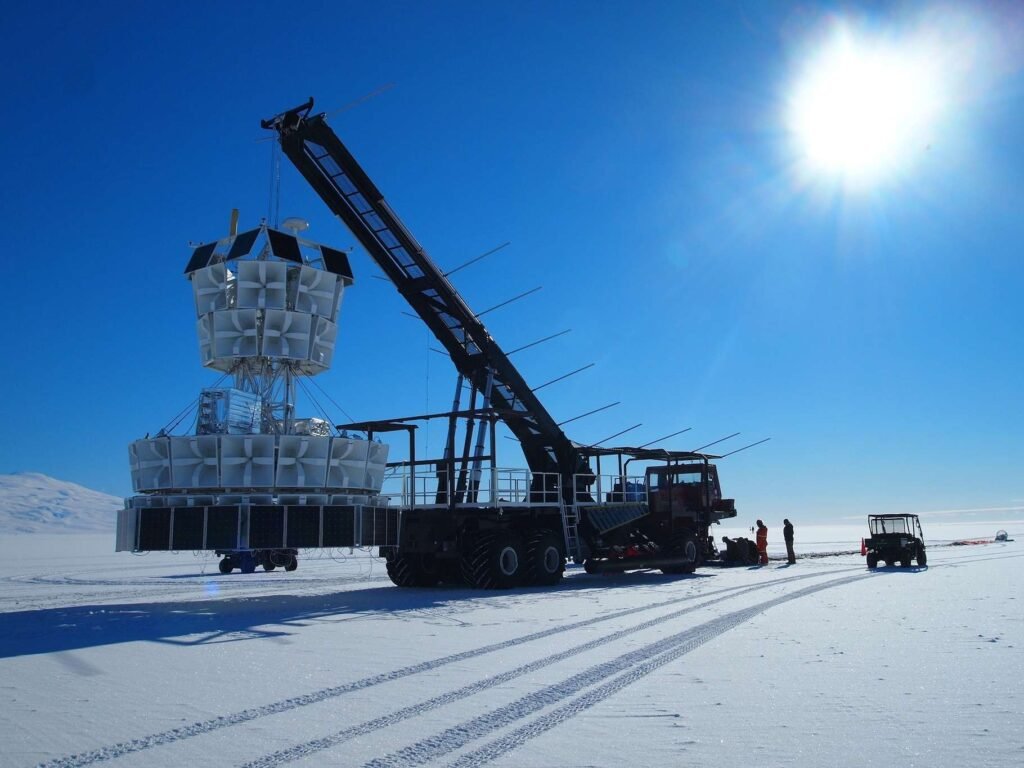
ANITA’s Discovery: Not Neutrinos After All
The research team’s initial suspicion was that the radio pulses had originated from neutrinos interacting with the ice, producing high-energy air showers that generate detectable radio signals. However, this assumption doesn’t hold up under scrutiny. The radio pulses detected during the experiment appeared at a much sharper angle—around 30 degrees below the surface of the ice—than predicted by existing models.
This misalignment between the expected and observed signal angles led scientists to reevaluate their initial hypothesis. The signals simply didn’t match what they knew about neutrinos or cosmic rays. Wissel and her team noted that these signals didn’t follow the expected pattern of reflections from the ice surface, which should have inverted the polarity of the signal.
While the possibility of high-energy neutrinos was dismissed, this discovery opened the door to other, more exotic theories. Could the signals be the result of something more elusive and unknown? The answer may lie in the realm of dark matter, a mysterious form of matter that interacts with gravity but doesn’t emit light, making it difficult to detect.
The IceCube and Pierre Auger Observatories Join the Hunt
To further investigate these strange radio pulses, the team turned to other major observatories, including IceCube, another experiment in Antarctica designed to detect neutrinos, and the Pierre Auger Observatory in Argentina, which focuses on ultra-high-energy cosmic rays. Both facilities were in a prime position to follow up on the anomalies recorded by ANITA. But neither provided any support for the idea that neutrinos or known cosmic particles were responsible for the strange signals.
In fact, according to Wissel, the Pierre Auger Observatory and IceCube experiments failed to record any signals that could explain the anomaly in ANITA’s data. The lack of supporting data from these two major facilities led the research team to consider new, more speculative ideas—perhaps the signals were not the product of known cosmic phenomena.
“The signals could potentially be an indication of dark matter,” Wissel speculated. “However, the absence of any complementary observations from IceCube and the Pierre Auger Observatory significantly limits this possibility.”
This left the team facing a complex conundrum. Despite the findings, the signals’ source remains unclear. Could they point to a new, unknown phenomenon, or perhaps suggest that something beyond the standard models of physics is at play?
Pueo and Future Observations
Despite the uncertainty surrounding the radio pulses, researchers are not giving up. To improve their understanding of these signals and possibly uncover new explanations, Wissel’s team is working on a more advanced detector, Pueo (Payload for Ultrahigh Energy Observations). Pueo is set to be larger and more powerful than its predecessors, which may allow it to detect similar anomalies and shed light on their true nature.
Pueo is designed to capture high-energy cosmic events, and its larger size and more advanced technology will enable it to potentially detect more anomalies like the ones observed by ANITA. By capturing even more detailed data, researchers hope to uncover the nature of these unexplained radio signals.
“Pueo could be instrumental in understanding what is happening,” said Wissel. She emphasized that Pueo’s potential for detection will be crucial in unraveling whether the signals are truly anomalous or if they point to a new discovery altogether.
The construction of Pueo at the University of Pennsylvania will allow scientists to expand their search for high-energy cosmic particles, such as neutrinos, and perhaps even unlock the secrets of dark matter. The researchers are hopeful that with the help of this next-generation detector, they will gain a much clearer picture of the phenomenon and how it fits into the broader understanding of the cosmos.
A Step Toward New Physics?
What began as an investigation into high-energy neutrinos has now evolved into something far more profound. The mystery surrounding these radio signals continues to fuel speculation about the existence of new particles, undiscovered forces, and potentially even dark matter. While the data collected from ANITA and its follow-up experiments hasn’t yet provided a conclusive answer, it has undoubtedly opened a door into uncharted territory.
With Pueo soon to take over the search for answers, the scientific community is on the edge of its seat, awaiting the next breakthrough. Whether these strange signals will ultimately reveal a groundbreaking discovery or simply remain an anomaly, only time will tell.

Related Posts

This Everyday Drink Could Be Accelerating the Aging Process in Your Cells—Scientists Uncover What Really Happens Inside Your DNA

7, 8, or 12 Hours? New Expert Data Reveals the Sleep You Truly Need by Age—Most People Are Off Track